We have not yet determined the reasons behind the relatively poor performance shown in last month’s CCA (China Consumer Association) test report. At this time, we would like to share our testing methodology to demonstrate that the Totobobo mask provides a high level of protection. Although the Totobobo mask is not a certified N95 respirator, we use an OSHA-compliant fit-testing device, the PortaCount® Pro+, manufactured in the USA by TSI.
由于信息有限,我们暂时无法确定Totobobo口罩为何在上月中国消费者协会的测试中表现欠佳。不过,我们可以公开我们检测Totobobo口罩的方法,以验证其对PM2.5的高效防护能力。尽管Totobobo不是一款获得N95认证的口罩,但我们采用符合OSHA标准、由美国TSI公司制造的定量测试仪——PortaCount Pro+进行了检测。
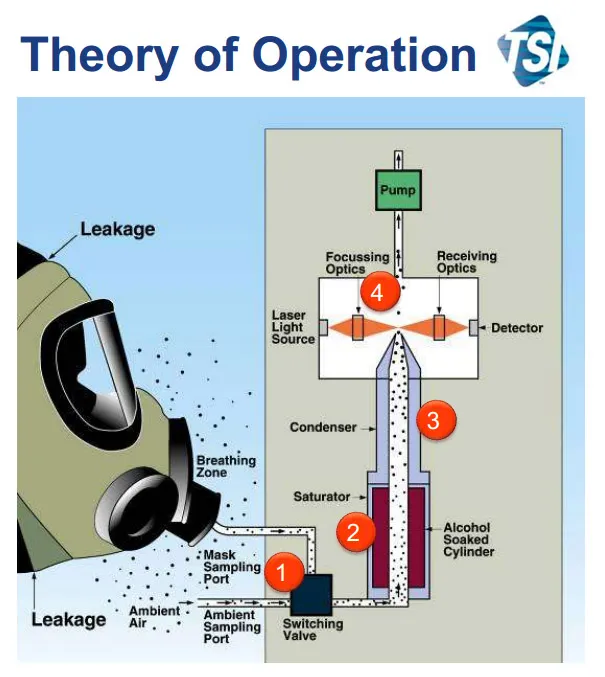
Theory of operation of a PortaCount Pro + Image credit: TSI
How does the fit tester work?
The PortaCount® Respirator Fit Tester measures how well a respirator seals to your face. It first detects the concentration of microscopic particles in the surrounding air. Then, it measures how many of those particles leak inside the respirator while it is being worn.
The comparison between these two measurements is called the Fit Factor. A higher Fit Factor means a better seal and stronger protection.
PortaCount® Pro+ 的工作原理是什么?它是如何进行口罩适配性测试的?
PortaCount® Pro+ 配备两根采样管:一根用于测量口罩内部空气中微小颗粒的浓度,另一根则测量口罩外部环境中微小颗粒的浓度。PortaCount® Pro+ 根据这两处浓度的比例计算出总密封度(Fit Factor),该指标综合反映了口罩的过滤效率与密合性。
WHAT IS A FIT FACTOR?
A Fit Factor measures how well a specific respirator seals against a person’s face. It is calculated as the ratio between the concentration of test particles (challenge aerosol) in the surrounding air and the concentration of particles that leak into the respirator through the face seal.
For example, a Fit Factor of 100 means the air inside the mask is 100 times cleaner than the air outside.
什么是总体保护系数(Fit Factor)?
总体保护系数(Fit Factor)指的是一个口罩对特定使用者的整体防护程度。该数值通过口罩内外颗粒物浓度的比值计算得出。总体保护系数为100,即表示口罩内部的空气比外部空气清洁100倍。N95口罩的总体保护系数必须达到或超过100。
Why is Quantitative Fit Testing (QNFT) better than Qualitative Fit Testing (QLFT)?
The PortaCount® Pro is a quantitative fit tester (QNFT). Unlike qualitative fit testing (QLFT), which relies on a person’s ability to taste, smell, or feel an irritant, QNFT uses objective particle measurements to determine how well a respirator fits.
Because it is instrument-based, QNFT removes subjectivity. The results are not influenced by an individual’s sensitivity, perception, or response. This makes the test more accurate and reliable. Another key advantage is that the wearer cannot influence or “pass” the test through guesswork – the numbers speak for themselves.
In the 9-minute video below, you can see the full quantitative fit testing process. The final result (at 8:48) shows that the Totobobo mask fitted with F96 filters reduced ambient particle levels by 142 times – achieving a Fit Factor of 142.
为什么定量测试比定性测试更准确?
PortaCount® Pro+ 是一款定量测试设备。定量测试优于定性测试,因为它消除了定性测试中可能影响结果的一些主观因素,例如受试者的味觉、嗅觉或对刺激性化学品的敏感度。在定量测试中,受试者无法通过主观感受干扰测试设备的客观测量结果。
以下为一段时长9分钟的视频,完整展示了使用PortaCount® Pro+进行定量测试的全过程。测试结果显示,Totobobo口罩的总体保护系数(Fit Factor)可达142,意味着口罩内部空气比外部空气洁净142倍,对应的总过滤效率为 1 – 1/142 ≈ 99.3%。(视频时间点:8:48)
http://tinyurl.com/totobobo-test
Fit-test-Totobobo Mask with TSI Portacount Pro 8038 from Francis Chu on Vimeo.
Intro to Quantitative Fit Testing (TSI)