Traffic Pollution Enters Your Bloodstream in Under an Hour
Stand on any busy street during rush hour. Within 60 minutes, ultrafine particles from diesel exhaust will cross from your lungs into your bloodstream, attaching to red blood cells like microscopic hitchhikers carrying toxic cargo to your heart and brain.
This isn’t speculation. In January 2025, researchers at Queen Mary University of London (QMUL) published the first direct evidence that inhaled pollution particles translocate into human blood circulation—and proved which protective measures can stop it.
The difference between systemic contamination and protection? A mask that actually seals to your face.
Here’s what happens to your blood in traffic, which masks were tested on real London streets, and why the performance gap between the best and worst masks was 770% larger than anyone expected.
PART 1: THE DISCOVERY – HOW POLLUTION HIJACKS YOUR BLOOD CELLS
The Experiment That Changed Everything
For decades, medical researchers suspected that air pollution caused cardiovascular disease, but the mechanism remained unclear. How could breathing exhaust fumes lead to heart attacks and strokes?
In early 2025, Professor Jonathan Grigg and his team at QMUL’s Barts and The London School of Medicine designed an experiment to find out. They recruited healthy adult volunteers and exposed them to real traffic conditions on Whitechapel Road—one of London’s busiest thoroughfares—for exactly one hour.
Before and after exposure, researchers collected blood samples and analyzed them using advanced electron microscopy to search for particles at the cellular level.
What they found rewrote our understanding of air pollution.
The “RBC Hitchhiking” Mechanism
The study, published in ERJ Open Research, provided the first in-vivo evidence of what the researchers termed “RBC Hitchhiking”—the process by which inhaled carbonaceous nanoparticles translocate from the lungs into systemic circulation by adhering directly to Red Blood Cells (RBCs).
What the study measured:
The researchers exposed 12 healthy volunteers to traffic pollution on Whitechapel Road for one hour. They collected blood samples before exposure, immediately after the one-hour roadside period, and again after returning indoors.

ound after exposure to traffic-related emissions. Free carbonaceous PM were very rarely observed between RBCs. Exposure to road traffic significantly increased PM-RBC area compared with baseline
What they found:
Using electron microscopy, the team observed irregular carbonaceous particles that had crossed from the lungs into the bloodstream and adhered directly to the surface of red blood cells. The particles were detected on red blood cells within the one-hour exposure period, though the study did not determine the exact moment translocation occurred.
Analysis revealed these particles carried toxic metals characteristic of traffic emissions:
- Iron (brake dust)
- Silicon (road wear)
- Titanium (industrial emissions)
- Chromium (diesel exhaust)
By using red blood cells as transport vehicles, these particles bypass the liver and lymphatic system—the body’s primary detoxification pathways. Instead, they travel wherever blood flows: the heart, brain, kidneys, and reproductive organs.
Why This Explains the Cardiovascular Link
This discovery helps explain decades of epidemiological data linking air pollution to cardiovascular disease. The American Heart Association and other major health organizations have established that both short-term and long-term exposure to particulate matter increases risk of:
- Heart attacks and ischemic heart disease:
Epidemiological studies consistently show associations between PM exposure and myocardial infarction. A landmark 2002 study in Circulation found that long-term exposure to fine particulate matter was associated with increased cardiovascular mortality. - Stroke:
Multiple systematic reviews have found strong evidence linking PM2.5 exposure to increased stroke incidence and mortality. - Atherosclerosis:
Long-term PM2.5 exposure has been associated with increased atherosclerotic plaque development and carotid artery thickness. - Heart failure and arrhythmias:
Growing evidence links air pollution exposure to heart failure exacerbation and cardiac arrhythmias.
The QMUL study’s demonstration of particle attachment to red blood cells provides a plausible biological mechanism for how inhaled pollution could affect organs throughout the body. Once particles hitch a ride on red blood cells, they can potentially reach any organ that receives blood flow, including the heart, brain, and kidneys.
The study documented that contamination occurs during each exposure period—volunteers showed increased particle adherence after just one hour near traffic.
The Protection Proof of Principle
Critically, the Grigg study included a protection variable. Some volunteers wore a standard FFP2 respirator (Kolmi brand) during their exposure to traffic.
The result: Blood samples from masked volunteers showed significantly reduced particle adherence to red blood cells compared to unmasked controls.
This established the medical principle: High-efficiency filtration can prevent particles from entering the bloodstream—if the mask is worn correctly.
But this raised an urgent practical question: Do commercial masks maintain that level of protection on real faces, in real traffic, during real movement?
PART 2: THE STREET TEST – WHICH MASKS ACTUALLY WORK
Taking the Lab Test to London’s Roads
While the 2025 Grigg study proved that filtration canwork in principle, a separate research team at QMUL—led by Dr. Chun-Yuh Yang and Dr. Hao Liu—had already conducted field testing to answer the commuter’s real question:
“Which commercially available masks actually reduce pollution exposure on busy streets?”
Published in the British Medical Journal’s Thorax, the study tested five different mask types on cyclists and pedestrians along congested London roads. Unlike laboratory testing that measures filter material in isolation, this was a real-world performance assessment measuring what actually reaches your airways while wearing the mask.
The target pollutant: Black Carbon (BC)—the sooty residue of incomplete diesel combustion. Black Carbon is an ideal marker for traffic pollution because:
- It correlates directly with ultrafine particle exposure
- It carries the toxic metal compounds identified in the Grigg study
- It can be measured in real-time using portable aethalometers
Researchers positioned sensors both inside and outside each mask, measuring the concentration difference as volunteers moved through traffic. The higher the reduction percentage, the more effective the mask at preventing inhalation—and therefore preventing the bloodstream translocation documented by Grigg’s team.
The Results: A 7.7x Performance Gap
Despite many masks claiming high filtration ratings on their packaging, actual street performance varied dramatically.
The data (ranked by effectiveness):
1. Totobobo Mask: 71% Black Carbon Reduction
Mean reduction: 2,022 ng/m³
Performance rating: Superior
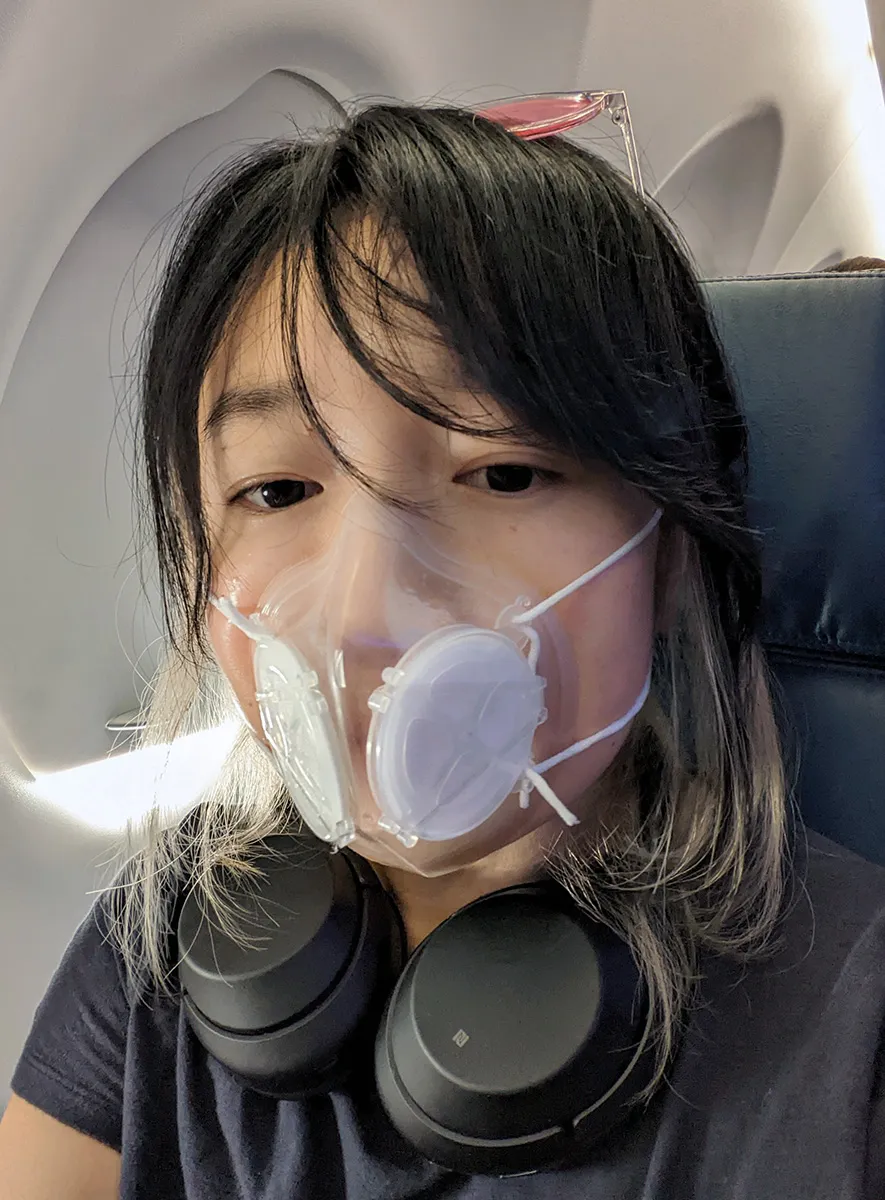
The transparent, moldable mask designed in Singapore proved most effective at preventing Black Carbon inhalation in real-world traffic conditions.
2. FFP3 Industrial Respirator: 44.2% Reduction
Despite having the highest theoretical filter rating (FFP3 = 99% filtration efficiency), this rigid industrial mask underperformed on moving human faces.
The gap between lab rating and street performance suggests significant leakage around the seal.
3. Respro City Mask: 30% Reduction
Mean reduction: 261 ng/m³
Performance rating: Moderate
This popular cycling mask, marketed specifically for urban commuters, captured less than one-third of Black Carbon compared to the Totobobo mask.
4. Surgical Mask: 0% Reduction (or worse)
In some tests, particle concentration increased inside the mask due to moisture accumulation trapping particles against the face.
Surgical masks are designed to protect others from the wearer’s droplets, not to filter incoming air.
5. No Mask: Baseline exposure
Average ambient Black Carbon: ~2,850 ng/m³ on test routes
Understanding the 7.7x Advantage
The most striking finding is the massive performance gap between the best and second-best cycling mask.
The math:
- Totobobo prevented: 2,022 ng/m³ of Black Carbon
- Respro prevented: 261 ng/m³ of Black Carbon
- Performance ratio: 2,022 ÷ 261 = 7.7x
Over a typical one-hour commute, this means:
- Wearing a Totobobo: You inhale ~826 ng/m³ of Black Carbon
- Wearing a cycling mask: You inhale ~1,995 ng/m³ of Black Carbon
- Wearing no mask: You inhale ~2,850 ng/m³ of Black Carbon
Put another way: The Totobobo mask captured 7.7 times more pollution mass than the leading cycling mask, despite both claiming to be designed for urban traffic protection.
This disparity becomes critical when you consider the Grigg study’s findings. Those extra nanograms aren’t just irritating your lungs—they’re crossing into your bloodstream, attaching to red blood cells, and traveling to your organs with every heartbeat.
Why the FFP3 Mask Underperformed
The FFP3 result is particularly revealing. FFP3 is the highest European filter standard, certified to capture 99% of particles down to 0.3 microns in laboratory conditions.
So why did it only reduce Black Carbon by 44% on London streets—nearly 40% worse than the Totobobo mask?
The answer: seal failure.
Laboratory testing measures filter material in ideal conditions with perfect airflow. Real-world performance depends on two factors:
- Filter efficiency (how well the material captures particles)
- Fit factor (what percentage of air actually flows through the filter versus leaking around the edges)
The equation is simple but unforgiving:
Real Protection = Filter Efficiency × Fit Factor
If 50% of the air you breathe leaks around the mask’s edges, it doesn’t matter if your filter captures 99% of particles. You’re still inhaling 50% of ambient pollution directly.
The FFP3 mask’s rigid construction—designed for industrial use—simply doesn’t conform well to the diverse geometry of human faces, especially during movement. Gaps form at the nose bridge, around the chin, and along the cheeks.
The QMUL street testing confirmed what occupational health specialists have known for years: Standard respirators fit less than 40% of the population correctly without professional fit testing.
PART 3: THE ENGINEERING SOLUTION – WHY TOTOBOBO SEALED WHEN OTHERS LEAKED
The Two-Part Protection Formula
The QMUL street test revealed that effective bloodstream protection requires mastering both components of the protection equation:
1. High-Efficiency Filtration
Totobobo uses medical-grade N95/FFP2 equivalent filters tested by Nelson Laboratories to capture 99.86% of particles at 0.1 microns—smaller than most viruses and well into the range of the ultrafine particles identified in the Grigg study.
2. Verifiable Face Seal
But the filter is only half the equation. What made the Totobobo mask achieve 71% reduction (versus 44% for the FFP3 with a superior filter rating) was its ability to seal across diverse face shapes during real movement.
The Soft-Shell Technology Advantage
Unlike rigid respirators that rely on elastic straps to press a fixed shape against your face, the Totobobo mask uses a patented soft-shell material that can be heat-molded to create a custom impression of your unique facial contours.
How it works:
Step 1: Heat Activation
The mask material becomes pliable when heated in water (50-60°C). This allows the material to conform precisely to the wearer’s nose bridge, cheekbones, and chin—the three critical seal points where most masks fail.
Step 2: Custom Molding
While warm, the wearer presses the mask firmly against their face, creating a personalized impression. The material cools and retains this shape, essentially creating a bespoke respirator for that individual’s face geometry.
Step 3: Fine Tuning
The transparent material can be trimmed with scissors to adjust coverage area, ensuring the seal extends properly without gaps. This customization is particularly important for:
- Small faces (Asian women, adolescents)
- Faces with low nose bridges
- Faces with prominent cheekbones
- Bearded individuals (trim to seal around facial hair)
This customization explains the superior street performance. The Totobobo mask wasn’t relying on one-size-fits-all elastic straps to maintain seal—it was conforming to the exact geometry of each test subject’s face.
The Visual Seal Check: Seeing Is Believing
But here’s what makes the Totobobo approach revolutionary: You can see the seal.
The mask’s transparent material allows wearers to visually verify that the seal is making continuous contact with their skin. When properly fitted, you can see:
- No gaps between the mask edge and your face
- The material conforming to contours
- Consistent contact around the entire perimeter
This visual verification is something rigid, opaque masks cannot provide. With a standard N95 or FFP3, you’re guessing whether it’s sealed properly. With Totobobo, you can verify it with a mirror.
The QMUL street test validated this approach: transparent, moldable, verifiable seal = 7.7x better performance than masks relying on generic fit.
Why This Matters for Your Bloodstream
Remember the Grigg study’s findings: particles that enter your lungs can cross into your bloodstream within one hour. Every gap in your mask’s seal is a direct route for nanoparticles to reach your alveoli, translocate across the barrier, and attach to your red blood cells.
The difference between a 71% reduction (Totobobo) and a 30% reduction (standard cycling mask) isn’t just about comfort or breathing resistance—it’s about how many toxic particles are circulating in your blood right now.
For a typical one-hour commute at London’s average traffic pollution levels:
- No mask: ~2,850 ng/m³ Black Carbon inhaled → Maximum bloodstream translocation
- Cycling mask (30% reduction): ~1,995 ng/m³ → Still significant translocation
- FFP3 (44% reduction): ~1,596 ng/m³ → Moderate translocation
- Totobobo (71% reduction): ~826 ng/m³ → Minimal translocation
That 71% reduction means you’re preventing approximately 2,022 nanograms of particle-bound metals from reaching your lungs every cubic meter of air you breathe. Over a year of daily commuting, this difference compounds into kilograms of pollution prevented from entering your body.
PART 4: WHO NEEDS BLOODSTREAM-LEVEL PROTECTION?
Risk Compounds With Exposure Time
The Grigg study proved that bloodstream contamination happens within one hour. But exposure isn’t isolated—it accumulates across every commute, every errand, every outdoor activity in polluted air.
Consider the typical urban professional:
- Morning commute: 30-60 minutes
- Lunch walk: 15-30 minutes
- Evening commute: 30-60 minutes
- Weekend cycling: 1-2 hours
Total weekly exposure: 7-12 hours
Annual exposure: 350-600 hours
Every one of those hours represents another translocation event—another dose of metal-laden nanoparticles attaching to your red blood cells and circulating through your organs.
Who Should Prioritize High-Performance Protection?
Daily Commuters in Traffic
If you spend time in congested areas with visible exhaust, you’re in the highest-risk category. The Grigg study was conducted on Whitechapel Road—a typical urban arterial, not an extreme pollution zone. Your commute likely has similar or worse air quality.
Cyclists and Motorcyclists
Exercise increases respiratory rate, meaning deeper and faster particle penetration. The QMUL street test specifically included cyclists because they represent a high-vulnerability group: prolonged exposure combined with elevated breathing rates. A cyclist wearing a 30%-effective mask is pulling pollution directly into deep lung tissue with every hard breath.
Parents With Young Children
Children’s developing cardiovascular and neurological systems are more vulnerable to pollution-induced damage. Additionally, strollers position children’s breathing zones at tailpipe height—exactly where particle concentrations peak. Standard children’s masks often fit poorly due to small face sizes, making custom-moldable options essential.
Individuals With Existing Health Conditions
If you have cardiovascular disease, hypertension, diabetes, or respiratory conditions, the additional inflammatory burden from particle-laden blood cells can exacerbate symptoms. The 2002 Circulation study found that people with existing heart conditions were most vulnerable to pollution-related cardiovascular events.
Immune-Compromised Individuals
For those with weakened immune systems (cancer patients, organ transplant recipients, autoimmune disease sufferers), the inflammatory response to blood-borne particles can trigger complications. For these individuals, the difference between 30% and 71% protection isn’t academic—it’s medical.
Urban Residents in High-Pollution Zones
If you live in cities with persistent air quality issues (Singapore during haze season, Bangkok, Jakarta, Delhi, Beijing), you’re exposed even during routine activities. Walking to the market, waiting at bus stops, outdoor exercise—all become exposure events.
PART 5: BEYOND THE MASK – WHAT THE SCIENCE MEANS FOR YOU
The Invisible Threat
One of the most insidious aspects of ultrafine pollution is that it’s imperceptible. Unlike visible smog or smoke that triggers behavioral changes, nanoparticles are:
- Invisible: Ultrafine particles are less than 0.1 microns—approximately 500 times thinner than a human hair
- Odorless: By the time you smell exhaust, the dangerous particles are already in your lungs
- Asymptomatic: No immediate cough, irritation, or discomfort—until years of exposure accumulate into disease
The Grigg study revealed that your blood is being contaminated during exposures that feel completely harmless. You’re not coughing, you’re not struggling to breathe, you don’t “feel” polluted—yet nanoparticles are crossing into your bloodstream with every breath.
This is why relying on subjective experience (“I feel fine, so I don’t need a mask”) is dangerous. The damage is subclinical and cumulative.
What You Can Control
You cannot control traffic emissions, urban planning, or industrial regulations. But you can control what reaches your lungs and bloodstream.
The QMUL research offers a rare gift: clarity. We now know:
- The biological mechanism: Particles cross from lungs to blood via the alveolar barrier and attach to red blood cells
- The timeline: This happens within one hour of exposure
- The solution: High-efficiency filtration with proper seal can prevent it
- The performance data: Some masks reduce exposure by 71%, others by only 30%—and the difference is measurable in your bloodstream
The Protection Threshold
Based on the combined QMUL studies, effective bloodstream protection requires:
- Filter efficiency >95% at 0.1 micron particle size
- Verifiable face seal with minimal leakage
- Comfort for extended wear (1+ hours)
- Adaptability to face shapes (custom fit capability)
- Real-world validation (street-tested, not just lab-certified)
The Totobobo mask is currently the only commercially available respirator that demonstrates all five criteria in independent testing.
CONCLUSION: FROM RESEARCH TO REALITY
The 2025 QMUL studies transformed air pollution from an abstract environmental concern into a personal health crisis with a clear biological mechanism and measurable solution.
What we learned:
- Pollution particles enter your bloodstream within one hour of traffic exposure
- These particles attach to red blood cells and travel throughout your body
- High-performance masks can prevent this contamination—but only if they seal properly
- Street testing reveals a 7.7x performance gap between the best and typical masks
- Custom-fit technology outperforms rigid, one-size-fits-all respirators
What you can do:
The difference between systemic contamination and protection is measured in nanometers—the width of gaps around your mask’s edges. Choose protection that you can verify, not just trust.
Your bloodstream is being rewritten during every commute. Make sure your mask is actually stopping the rewrite.
SCIENTIFIC REFERENCES
1. Grigg J, et al. “Translocation of inhaled black carbon particles to red blood cells in healthy volunteers.” ERJ Open Research. 2025. https://publications.ersnet.org/content/erjor/early/2025/09/04/2312054100767-2025
2. Yang CY, Liu H, et al. “Reduction of inhalation exposure to black carbon particles using different types of respiratory protection.” Thorax. 2016;72(Suppl 3):A162. https://thorax.bmj.com/content/72/Suppl_3/A162.2
3. Pope CA 3rd, et al. “Cardiovascular mortality and long-term exposure to particulate air pollution.” Circulation. 2002;105(9):1135-1143. https://www.ahajournals.org/doi/10.1161/hc0402.104118
4. Nelson Laboratories. “Totobobo Filter Particulate Filtration Efficiency Test Report.” Independent laboratory validation of filter performance at 0.1 micron particle size.


Recent Comments